Showing posts with label theology quotes. Show all posts

9.24.2014

Theology Quotes: Rosemary Radford Reuther

I'm digging back into the research for my MA thesis. My working title is "Human Trafficking as Social Sin: An Ethic of Resistance." Next week I am going to start writing, but for now I'm finishing up reading on social sin.  One of my sources led me to look back at Rosemary Radford Reuther's classic text, Sexism and God Talk: Toward a Feminist Theology.  She of course is writing (rightly) specifically about the social sin of sexism, but it applies to all "isms" and forms of social sin.

I especially appreciate how she both draws distinctions and makes the connection between individual responsibility and the systemic nature of social sin. Change begins with us, here and now, in our relationships with God, self, and other through our choices and identity as authentic human persons.


8.15.2014

Suffering, Remaining & Witness

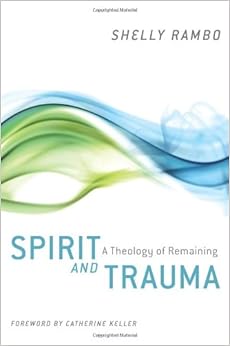
I was delighted to see that Nancy Schreck, OSF drew upon the work of Shelly Rambo in her 2014 LCWR Keynote address.  I have been reading (and re-reading) Rambo's Spirit and Trauma: A Theology of Remaining (2010 Westminster John Knox Press) these days. I first used Rambo's book for a paper I wrote on the ministry of reconciliation with trafficked persons. I'm now using it as part of my thesis work (today in fact .... it sits open before me as I procrastinate in my research with this blog post!)

It was interesting to read Schreck apply Rambo's work on trauma to the place where women religious find themselves today.
This shifting within religious life and in world events has taken us to what I call a middle space. We find ourselves in this place of both creativity and disorientation. Much of what was is gone, and what is coming is not yet clear. ... 
I am greatly helped in this next section by the work of Shelly Rambo and her book Spirit and Trauma: A Theology of Remaining. Rambo speaks about a theology of remaining in difficult places because "when you enter certain worlds, they do not let you go."  
Though her work is with trauma survivors and in no way do I want to diminish the aspect of trauma, I do think some parallels with or experience can be drawn. ... 
The task of "remaining" in this uncertain place is to pay attention to the reality that does not go away. In this experience all of our theological categories are re-defined: concepts like love, divine presence, incarnation, and world view are reshaped. Knowledge, truth, and experience of our world are transformed, placed on much more fragile terrain because of the radical disruption ... 
What we try to do in the middle space is to describe events that shatter all that one knows about the world and the familiar ways of operating within it. What if from this place we simply witness to and provide testimony about this experience, with special attention to truths that often lie buried and are covered over. ... 
In this middle space that is what we do: we call attention to things, things others might bury, or are afraid to face. That is why I say, however long the night we will be faithful and we will speak about what we are learning in the middle space. We trust Holy Mystery revealed in our midst. (Excerpt, Schreck, pages 7-10)

I need to think and pray into that some more, especially as it relates to my experience as a woman religious.

I've certainly been thinking and praying with a heavy heart today about the immense (human induced) suffering in our world today. And I mean, quite literally, today. A friend recently posted a very poignant list she's been carrying around with her these days: "Ferguson (police state, Black Man Walking), Gaza, Ukraine, Malaysian Air Flt 17, Refugee kids fleeing violence in Central America, Yazidi's fleeing the Islamic State, The Islamic State, Syria, Afghanistan, Ebola ..." No doubt you have your own (similar) list. It seems to be growing by the day.  So much violence, oppression, death, and trauma being caused to human beings by other human beings. One can feel paralyzed, helpless, or even complicit.  Our globalized media savvy reality means that we are present to this suffering on one (superficial/virtual) level, even though the vast majority of us are removed in our privileged spaces of comfort and safety. In my case, I think that's at the root of much of my own sense of being uncomfortable in my own skin as human induced suffering rages on and seemingly spreads. Removed as I/we are from the reality of suffering, I worry that it becomes easier to ignore or fail to act against it, thereby fueling more suffering.

Which is where I find Shelly Rambo's work so helpful:

In our current world, we are witnessing ongoing atrocities and different manifestations of suffering. The invisible forces of global capital and the undetectable effects of new wars and their justifications demand that theological accounts of suffering attend to the elisions constituting traumatic suffering. Although some may say that all 'suffering is suffering,' there are different expressions of that suffering and its effects that press for renewed theological articulation. I understand this as the increased invisibility of suffering and the power of its erasure. The discourse of trauma engages these invisible realities, continually calling attention to what falls outside the lines of what is, or can be, represented. The challenge of theological discourse is to articulate a different orientation to suffering that can speak to the invisibility, gaps, and repetitions constituting trauma.... 
A theology of the middle Spirit can help us rethink the theological discourse about suffering, given its new unique dimensions in trauma. Bessel van der Kolk acknowledges that one of the primary effects of trauma is a crisis of the human spirit. This crisis refers to a complete loss of meaning and trust in the world. ... How does a theology of the Spirit meet this crisis of spirit? ... 
I have started to envision practices patterned after this testimony, practices of tracking and sensing that propel us to recognize suffering amid its multiple elisions. .... 
The tracking and sensing, then, not only unearth and give theological significance to the unknown and unutterable within human experience, but these practices also testify to something of who we understand God to be. The work of the witnesses is to track the undertow and to sense life. But this witness is, as well, a testimony that runs deeper than we might imagine, to the nature of divine love. In the middle, divine love is witnessed in its remaining. ...The work of tracking and sensing is sanctifying work, the work of making love visible at the point where it is most invisible. 
If we read this sacred story as a story of survival, we are pressed to think about what it means to remain in the aftermath of a death that escapes our comprehension. To witness this sacred story is also to receive it for the truth that it tells: love remains, and we are love's witnesses. ... 
From this space, a different vision of life can be glimpsed. It is life as remaining. This transformation, this redemption in the abyss of hell, is not about deliverance from the depths but, instead, about a way of being in the depths, a practice of witnessing that sense life arising amid what remains. The middle story is not a story of rising out of depths, but a transformation of the depths themselves. 
(Excerpt, Shelly Rambo, Spirit and Trauma: A Theology of Remaining, 169-172)
A lot of words, many of them big theology words. But really, if I am even beginning to understand their power, I think it is summed up best by these two contrasting photos that have come out of Fergusson:


Top: Violence, suffering, and trauma.
Bottom: Witness, remaining, and healing.

7.19.2014

Resisting Evil ... Forging Hope

The liturgical readings for this Saturday seem tailor made for our present news cycle.

From the prophet Micah, we hear:

Woe to those who plan iniquity,and work out evil on their couches; In the morning light they accomplish it when it lies within their power. They covet fields, and seize them; houses, and they take them; They cheat an owner of his house, a man of his inheritance.
The Psalmist writes:
Why, O LORD, do you stand aloof? Why hide in times of distress? Proudly the wicked harass the afflicted,who are caught in the devices the wicked have contrived. 
For the wicked man glories in his greed, and the covetous blasphemes, sets the LORD at nought.The wicked man boasts, “He will not avenge it”;“There is no God,” sums up his thoughts. 
And then in Matthew's Gospel: 
The Pharisees went out and took counsel against Jesusto put him to death. When Jesus realized this, he withdrew from that place. Many people followed him, and he cured them all, but he warned them not to make him known.
Our present news cycle is filled with the consequences of evil planned on couches. Peoples are plotting against other peoples or closing their hearts and doors to compassion and our common humanity. There are good news stories to be sure as well, but those do not get the air time. Instead, we are submerged in woe.

Jesus could have been submerged in woe. People were literally planning his death. And what does he do? He withdraws from the place ... he was a man of deep prayer. Yet when people followed him, he did not ignore them or push them away, but ministered to them.

At our last CSJP Congregation Chapter, we wrote these words in our Chapter Act: "We live in a society marked strongly by the violence of war, violence to people through poverty and a sense of powerlessness and alienation, violence to earth, sea, and sky--violence that is truly cosmic."  Those words would also fit our present news cycle! As a community pursuing justice and seeking God's peace, how did we respond in our Chapter Act? "In response we commit ourselves to grow more deeply toward a nonviolent way of being and acting as peacemakers." Like Jesus, our call is to withdraw (resist) and to respond in hope.

A few months ago I read something by the great liberation theologian Gustavo GutiĆ©rrez regarding hope. I'd like to end this Saturday morning reflection with his words:
Hope is, in the first place, a gift from God. Accepting this gift opens followers of Jesus to the future and to trust … God’s gift is not an easy hope. But as fragile as it may seem, it is capable of planting roots in the world of social insignificance, in the world of the poor, and of breaking out and remaining creative and alive even in the midst of difficult situations. Nonetheless, hope is not waiting; rather it should lead us actively to resolve to forge reasons for hope.
No matter what the news, let us resolve to forge reasons for hope.

3.12.2014

Theology Quotes: Eric H.F. Law

It's cool when you get a chance to read work for school by someone you've actually interacted with in real life.  This semester I'm reading an oldie but goodie by Eric H.F. Law for my class on spirituality and leadership, 1993's The Wolf Shall Dwell with the Lamb: A Spirituality for Leadership in a Multicultural Community.

I've never met Eric Law, but I did work with him a little in my role as editor of A Matter of Spirit, the quarterly journal of the Intercommunity Peace and Justice Center in Seattle. In that role, I had the unique opportunity to cold call (or cold email as the case may be) lots of folks, from Richard Rohr to Michael Crosby to Elaine Prevallet to Frida Berrigan (Catholic theology/religious life/peace activist nerds will know who those folks are). The conversation went something like this: "I'm the editor of a journal for a peace and justice center in Seattle. We've got an upcoming issue on X and think that you would be uniquely positioned to break open the topic for our readers." Then, assuming they were still on board, I'd give them a very short time line, an outline of what we were looking for, and break the news that this would be pro bono. I was often amazed at the gracious response and genuine desire to move the conversation forward with our readers. (Sometimes of course my cold calls/emails went into a black hole where they were never to be seen again).

This is a long way of saying that I had one of these interactions once upon a time with Eric Law. Except that he exceeded my expectations.  Not only was he gracious and genuinely desired to break open the key elements of culture and diversity for our readers, he surprised me. You see, his article was due the day after our nation executed it's target killing/assassination of a certain big name terrorist. Fear of the big bad wolf was replaced by college students partying in the streets. It was a strange moment, if you recall. Anyway, that morning I had an email from Eric Law. He asked for an extension, not because his article wasn't finished (it was), but because given this change of events he knew he had to approach it differently. Two days later, he sent me this article: Fear: Conqueror, Exploiter, and Miner.  Not only was the article amazing, I was impressed by his integrity, honesty, and commitment to this little side project for a small non-profit in Seattle.

Back to my homework. I spent a bit of time this afternoon reading his chapter on the need for leaders in multicultural community to be engaged in power analysis. It really struck a chord and is something I want to spend more time reflecting upon (and trying on). So I thought I'd share it with you, my bloggy friends!


3.03.2014

Theology Quotes: Kenneth Himes

My bureaucratic past, political childhood and political science education are neatly meeting my religious life and study of theological ethics these days in a course titled "Catholic Moral Teaching and Public Policy Debates."  Our main text is hot off the presses (2013): Christianity and the Political Order: Conflict, Cooptation, and Cooperation by Kenneth R. Himes, OFM, a professor of Christian Ethics at Boston College. It's a great book that looks at the engagement of Christianity, specifically the Catholic Church, with the state and political realm in historical and global context.

This week, I read some of his thinking about social sin (a major research interest of mine). I figured this was highly appropriate as we move into Lent with Ash Wednesday approaching. Not familiar with Social Sin? "Social sin refers both to the ways in which our personal sins become embodied in unjust social structures and to the ways in which these structures, having taken on an independent life of their own, make it harder to resist the evil they embody" (Himes, 249). For example, an act of discrimination or hate speech is a personal sin, but is embedded in our social structures as racism, which takes on an independent life of its own, in a sort of vicious cycle. With that mini course in social sin 101, I give you this quote from Himes to ponder:


2.26.2014

Theology Quotes: Lisa Sharon Harper

I'm taking a course this semester on Spirituality and Leadership. The course has just started but we've already heard a wonderful variety of voices.  This week, our readings include an article by Lisa Sharon Harper, the director of mobilizing for Sojourners. I heard her speak a few years ago at an Interfaith Immigration breakfast in Seattle and was deeply inspired by her commitment to a lived faith that does justice. I just finished reading her chapter, "Singing the Creator's Song in a Strange Land," in the book Learning to Lead: Lessons in Leadership for People of Faith. I am challenged and inspired by this quote, which I in turn share with you in the latest installment of Theology Quotes on the blog.


2.22.2014

Theology Quotes: Merton

Last year I wrote a paper on Merton's ecological spirituality in dialogue with his spirituality of peace. I've had reason to re-read the paper of late, and I continue to be struck with his understanding of our spiritual and moral crisis. We are so very busy. We are so out of touch, both with what matters and the devastating impacts of our actions. We do not understand. Imagine what he would say today!


2.19.2014

New Blog Feature: Theology Quotes

Given that I spent an inordinate amount of my time reading theology and will be doing so for the next year and a half, I decided to add a new feature to the blog: Theology Quotes. Our first installment comes from an article by Gustavo GutiĆ©rrez titled "The Option for the Poor Arises from Faith in Christ," in Theological Studies 70 (2009) 317-326. Rather than overload you with words or long quotes, I have distilled his message into the following:


Amen!


Feel free to share the photo on Facebook, Twitter or your own blog!